
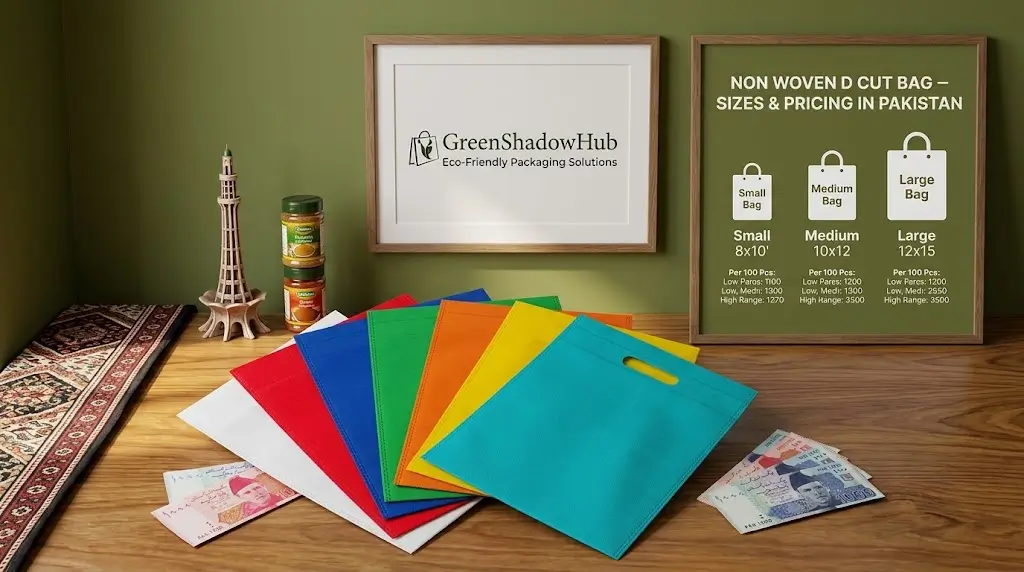
Stand outside any busy pharmacy on a Saturday evening in Faisalabad and watch what customers walk out with. Nine times out of ten these days, it’s not a plastic bag anymore it’s a simple, D-shaped handle bag in plain fabric, holding a strip of medicine or a small skincare purchase. Nobody thinks twice about it. That’s exactly the point. The non woven D cut bag has become so common across pharmacies, boutiques, and small retail counters in Pakistan that it’s stopped looking like a “green initiative” and started looking like just… how bags work now.
I’ve spent time talking to retail owners about why this specific style caught on faster than other reusable options, and the answer keeps coming back to something simple: it’s cheap enough to hand out for free with every purchase, but sturdy enough that customers don’t immediately throw it away. That combination is rare, and it’s why this bag style has quietly become a default across so many small counters.
A D cut bag gets its name from the handle shape a curved cutout at the top that forms a “D” on each side, doubling as both the carrying handle and part of the bag’s structure. It sounds like a minor design detail, but it solves a real manufacturing and cost problem.
Because the handle is cut directly from the same piece of fabric as the bag body, there’s no separate handle stitching required, which keeps production costs lower than bags with sewn-on straps or rope handles. For a pharmacy or small retail shop handing out dozens or hundreds of bags a day, that cost difference adds up fast. It’s the reason D cut bags tend to be one of the most affordable non-woven options on the market while still holding up better than thin plastic.
There’s also a practical comfort factor retailers don’t always think about upfront. The wide handle opening distributes weight across more of the hand and wrist compared to thin plastic handles that dig in when a bag gets heavy. Customers carrying a bag stuffed with medicine boxes, cosmetics, or small retail items notice this difference immediately, even if they can’t articulate why one bag feels more comfortable than another.
For businesses specifically, the D cut style also prints cleanly. The flat front and back panels give a decent surface for a logo, and because the bag is produced in high volume at low cost, branding it doesn’t push the price into territory that makes handing them out for free impractical which matters a lot for pharmacies, small boutiques, and grocery counters that give away a bag with every purchase rather than charging for it separately.
I keep running into the same handful of issues when businesses order this bag type without thinking it through.
Choosing the wrong size for the actual product range. A pharmacy handing out both small medicine strips and larger items like baby products or bulkier skincare sets often tries to force everything into one bag size. This either wastes material on tiny purchases or leaves larger items poking out awkwardly. It’s usually smarter to stock two sizes and match the bag to the purchase.
Going too thin on fabric weight to cut cost. Since D cut bags are already priced to be given away freely, some businesses push the fabric weight down even further to save a rupee or two per piece. The result is a bag that tears at the handle cutout the exact stress point where the bag needs to be strongest — within the first real use.
Skipping reinforcement at the handle curve. The curved cutout is a natural weak point structurally, since it’s cut directly into the fabric rather than reinforced with a separate strap. Cheaper manufacturing skips any reinforcement stitching around this curve, which is almost always where the bag fails first.
Not accounting for actual daily volume when ordering. A pharmacy or shop that hands out 100+ bags a day needs a genuinely different order quantity and reorder schedule than a boutique handing out ten. Ordering the same batch size regardless of actual turnover means either running out constantly or overstocking storage space with bags that sit unused for months.
Non woven D cut bags are priced by size, fabric weight, and whether printing is involved.
On pricing, unbranded D cut bags typically run in the range of Rs. 8–18 per piece depending on size and fabric gauge, with bulk orders of 1,000 pieces or more bringing that down noticeably often the cheapest per-unit non-woven option available precisely because of the low-waste, cutout handle design. Custom printing with a shop’s logo usually adds Rs. 3–7 per piece depending on print complexity.
For a pharmacy handing out 150 bags a day, that’s a monthly packaging cost somewhere around Rs. 36,000–65,000 depending on size and branding a number that sounds significant until you compare it to the current cost and legal risk of sourcing plastic bags in provinces actively enforcing bans.
Before placing a bulk order, run through this:
The reason the non woven D cut bag has spread so quietly across pharmacies and small shops in Pakistan is precisely because it doesn’t try to be memorable. It just does the job carries the purchase, survives the walk home, costs little enough to give away for free, and doesn’t add to the plastic pile every province is now cracking down on. That’s not a flashy pitch, but it’s an honest one, and it’s why this bag style keeps showing up at counter after counter without anyone making a big deal of it.
If your pharmacy, boutique, or retail counter is still handing out plastic with every sale, it’s worth looking at a properly made alternative that costs about the same but doesn’t put you on the wrong side of enforcement. Green Shadow Hub manufactures both the 8×12.5 and 10×12.5 D cut sizes, built with the reinforcement that keeps them from failing right at the handle.
WhatsApp us