
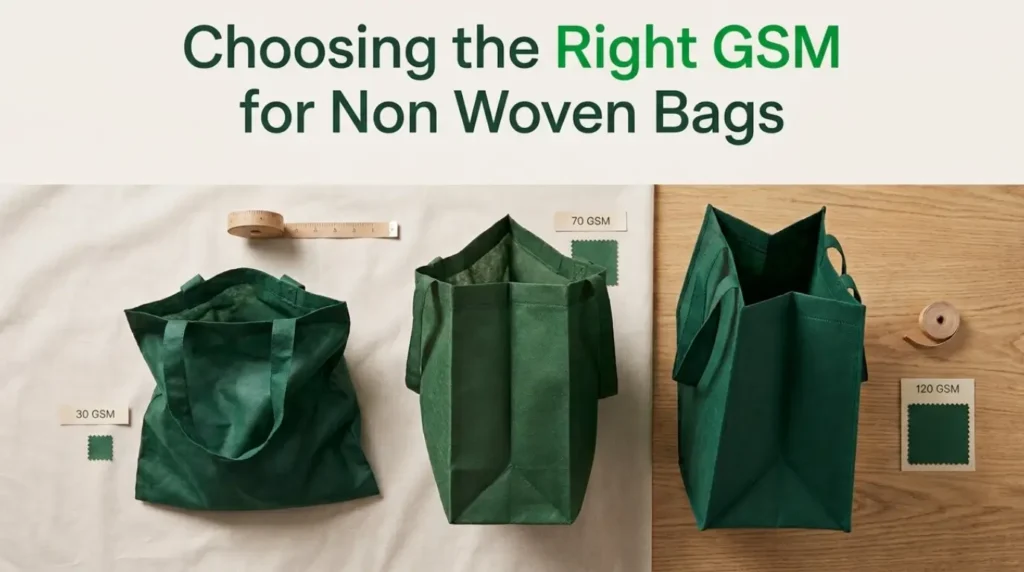
If you’re sourcing non woven bags for your shop, your brand, or your export order, the GSM you pick determines whether your bags survive a monsoon commute or end up as a customer complaint. GSM grams per square meter measures the weight and density of the non woven fabric. Higher GSM generally means thicker, sturdier material. Lower GSM means lighter, cheaper, more foldable. Simple in theory. In practice, getting it wrong costs money, reputation, and repeat business, which is why choosing the right GSM for non woven bags deserves more thought than a two-minute phone call with your supplier.
Pakistan’s non woven bag industry has exploded over the last five years, partly because of plastic bag bans in Punjab and Sindh, and partly because retailers finally realized customers notice packaging quality even when they don’t say so out loud.
Here’s the thing people underestimate: our climate and our retail habits are brutal on packaging. Bags get stuffed with vegetables still wet from the thaila wala’s spray bottle. They sit in car boots at 45°C in June. They get reused four or five times because customers are thrifty, not because you designed them for durability. A bag that’s fine in a controlled showroom environment can fail spectacularly in a Karachi sabzi mandi or a Lahore textile godown.
There’s also the branding angle, and this is where a lot of business owners leave money on the table. A flimsy, see-through bag with your logo on it doesn’t just fail functionally it actively undermines the brand message you’re paying for. I’ve seen boutique owners spend serious money on a beautiful print job, only to put it on 60 GSM fabric that wrinkles and sags the moment it’s filled. The customer’s first physical interaction with your brand outside the store is that bag. If it feels cheap, guess what impression sticks.
And then there’s cost control on the other end. Businesses ordering bulk grocery bags or event giveaways sometimes over-order on GSM out of anxiety “let’s just go heavy so we don’t have complaints” and end up paying 20-30% more per unit than necessary for a bag that’s carrying a single juice bottle for ten minutes.
Mistake one: picking GSM by price alone. This is the most common one, especially with first-time buyers who are comparing three quotes on a spreadsheet. The lowest quote often comes from the lowest GSM. What the quote doesn’t show is the failure rate, the returns, the reprint cost when customers complain. A bag that costs Rs. 2 less per unit but fails one time in twenty isn’t actually cheaper.
Mistake two: assuming one GSM fits every product line. A boutique selling scarves and a supermarket selling rice cannot use the same GSM and expect good results from both. Yet plenty of businesses order one bulk batch across their entire product range because it’s administratively simpler. It’s simpler right up until the heavy-goods version starts tearing.
Mistake three: ignoring the difference between GSM and gauge or thickness claims. Some manufacturers, particularly smaller local units, quote “thickness” or use vague terms like “heavy duty” without giving an actual GSM figure. Without the number, you’re buying blind. Always ask for the specific GSM in writing, and where possible, ask for a sample swatch you can physically stretch and tear-test yourself.
Mistake four: forgetting handle stress in the calculation. People obsess over the body fabric GSM and forget that handles take the brunt of the weight, especially with looped or D-cut handles. A bag can have solid body GSM and still fail because the handle stitching wasn’t reinforced for the load. This isn’t strictly a GSM issue, but it’s the mistake that gets blamed on GSM most often.
Here’s a rough breakdown of what you’re realistically looking at in the Pakistani market as of recent pricing trends. These shift with fabric costs and dollar rates, so treat them as a working reference, not gospel.
Printing adds its own cost layer on top, and it’s worth knowing that heavier GSM fabric generally takes screen printing better than very light fabric, which tends to pucker under ink. If your brand identity depends on crisp, clean printed logos, that’s a real factor, not a minor detail.
One thing worth saying plainly: don’t let anyone convince you that GSM alone determines quality. Weave density, the quality of the raw polypropylene granules used, and the manufacturing process all affect strength too. Two bags at the same GSM from two different mills can perform very differently. GSM is your starting filter, not your final answer.
Before you place your next bulk order, run through this:
That shopkeeper in Faisalabad switched suppliers after the torn-bag incident, not because he suddenly became a GSM expert, but because he finally asked the right question before ordering instead of after complaining. That’s really the whole lesson here. GSM isn’t a spec you glance at once and forget it’s a decision tied directly to what your customers experience the moment they walk out of your store carrying something with your name on it. Get it right, and nobody notices. Get it wrong, and everybody does.
If you’re still figuring out the right GSM for your specific product line, it’s worth talking to a manufacturer who’ll actually ask about your use case instead of just quoting a price. That’s the kind of conversation the team at Green Shadow Hub (greenshadowhub.com) tends to have with new clients before any order gets confirmed.


WhatsApp us