Last Ramadan, I watched a grocery store owner in Gulshan-e-Iqbal hand out forty-three plastic bags in under an hour. Every single one cost him money he’d never see back. His margins on a bag of atta are already razor thin, and here he was, quietly bleeding rupees on packaging nobody even thanks him for. When I asked why he didn’t switch to cloth, he shrugged and said “yeh sab time lega, abhi busy hoon.” That was eight months ago. He’s still using plastic. His neighbor two shops down switched in March and now prints his shop name on canvas totes that customers actually reuse and bring back.
That’s the real story behind the benefits of reusable shopping bags for businesses in Pakistan right now it’s not some abstract environmental talking point, it’s a plain business decision that either saves you money or costs you customers, depending on which side you land on.
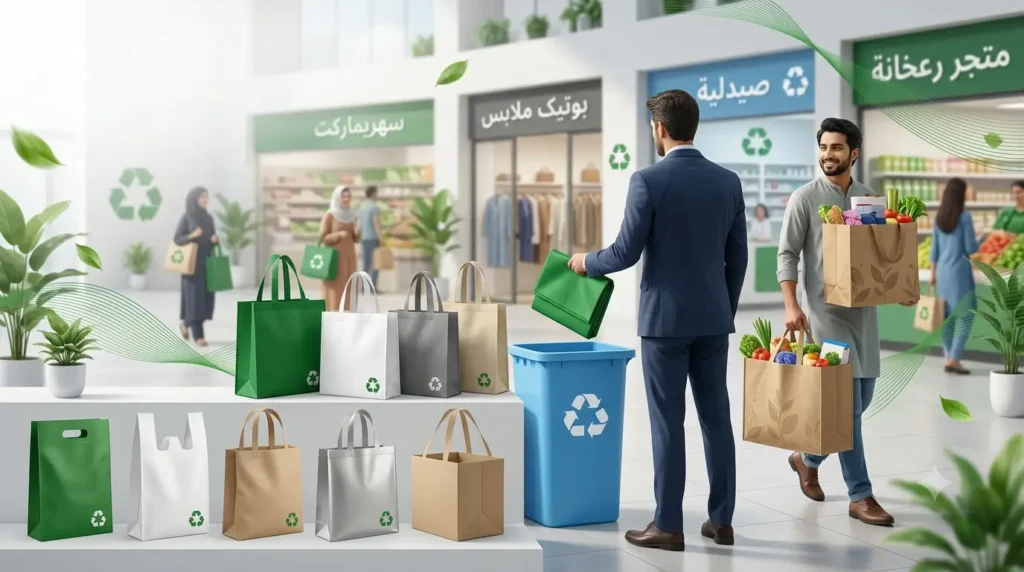
Punjab banned single-use plastic bags in phases starting 2023, Islamabad followed with its own crackdown, and Sindh has been tightening enforcement in Karachi’s commercial areas on and off for years. Whether or not the enforcement feels consistent to you, the direction is obvious. Businesses that got ahead of it aren’t scrambling now. The ones that didn’t are either paying fines, paying inflated black-market plastic bag prices, or losing customers who’ve simply started expecting something better.
Here’s what a lot of business owners miss: this isn’t just about avoiding a fine from the local municipal committee. It’s about what your packaging says about you before a customer even opens their mouth.
Walk into two identical bakeries in DHA. One hands you your order in a thin plastic bag that’s already stretching under the weight of a birthday cake. The other hands it to you in a sturdy jute or canvas bag with their logo stitched on. You don’t need a marketing degree to know which one you’ll remember, and which one you’ll photograph for Instagram.
There’s also the cost side, which nobody talks about enough. Plastic bag prices in Pakistan have gone up sharply over the last two years as raw material costs rose and legal supply shrank due to bans. Retailers who used to buy plastic bags for a few rupees a piece are now either paying more for “compliant” alternatives or buying from unregulated suppliers at inflated rates, sometimes risking confiscation or fines during raids. Reusable bags flip that equation. You pay once, upfront, and the cost per use drops every single time a customer brings it back or keeps using it.
And frankly, customers notice. Textile exporters, boutique owners, even wholesale grain dealers I’ve spoken with in Faisalabad say the same thing in different words: people are starting to ask why a shop still uses plastic. That question alone should tell you something.
Switching to reusable shopping bags sounds simple. In practice, I’ve seen the same handful of mistakes over and over, and each one quietly kills the return on investment.
Buying the cheapest bags available. A lot of shop owners treat this like a checkbox buy the cheapest non-woven polypropylene bag, slap a logo on it, done. Problem is, those ultra-thin bags rip after two or three uses, which defeats the entire purpose. Customers throw them away just like plastic, except now you paid three or four times more per bag for something that lasted a week.
Not printing branding on the bag. This one baffles me. You’re already paying for the bag — why would you not use it as free advertising that walks around the city on someone’s shoulder? A plain, unbranded reusable bag is a missed opportunity, full stop.
Switching without telling customers why. Some businesses just quietly swap bags with zero explanation, and customers assume it’s a cost-cutting move rather than a compliance or sustainability decision. A single line on your receipt or a small sign at the counter “Ab hum eco-friendly bags use kar rahe hain” changes the entire perception.
Treating it as a one-time purchase instead of a system. Bags get lost, get dirty, wear out. Businesses that order once and never restock end up back on plastic within three months because they ran out and panicked. That’s not a bag problem, that’s a planning problem.
This is usually where the hesitation comes from, so let’s be honest about it.
Compare that to plastic. A small retailer handing out 100 plastic bags a day, at even a conservative Rs. 5 per bag in current market rates, is spending roughly Rs. 15,000 a month on packaging that gets thrown away within minutes of the customer leaving the shop. A one-time order of 500 branded canvas bags, even at the higher end of Rs. 150 each, comes to Rs. 75,000 which sounds like a lot until you realize those bags don’t need reordering every month, and each one functions as walking advertisement for as long as it survives, often a year or more.
The math isn’t close once you look at it over six months instead of one transaction.
Before you call a supplier or place a bulk order, run through this:
Go back to that Gulshan-e-Iqbal grocer. Eight months of hesitation cost him roughly Rs. 120,000 in plastic bag spending he’ll never recover, plus at least one fine during a municipal check last month. His neighbor spent Rs. 40,000 upfront on branded canvas totes back in March and hasn’t reordered plastic since customers bring the same bags back weekly, and his shop name has quietly traveled across half the neighborhood on people’s shoulders.
Neither one set out to make a statement about the environment. One just did the math sooner.
If you’re weighing this decision for your own business, whether it’s a single retail counter or a distribution operation moving hundreds of orders a week, it’s worth talking to people who actually source and supply these bags at scale rather than guessing at fabric weights and pricing on your own. Green Shadow Hub works with businesses across Pakistan figuring out exactly this what material fits your product, what quantity makes sense, and how to make the switch without the guesswork that cost that grocer eight months and counting.